
Peepal Baba: The Man Who Turned Tree Plantation into a Way of Life
One of the defining features of Peepal Baba’s environmental work is location. Instead of planting trees in controlled or ceremonial spaces, he has focused on public land—places where trees are most needed but least prioritized.
FEATUREDINSPIRATION
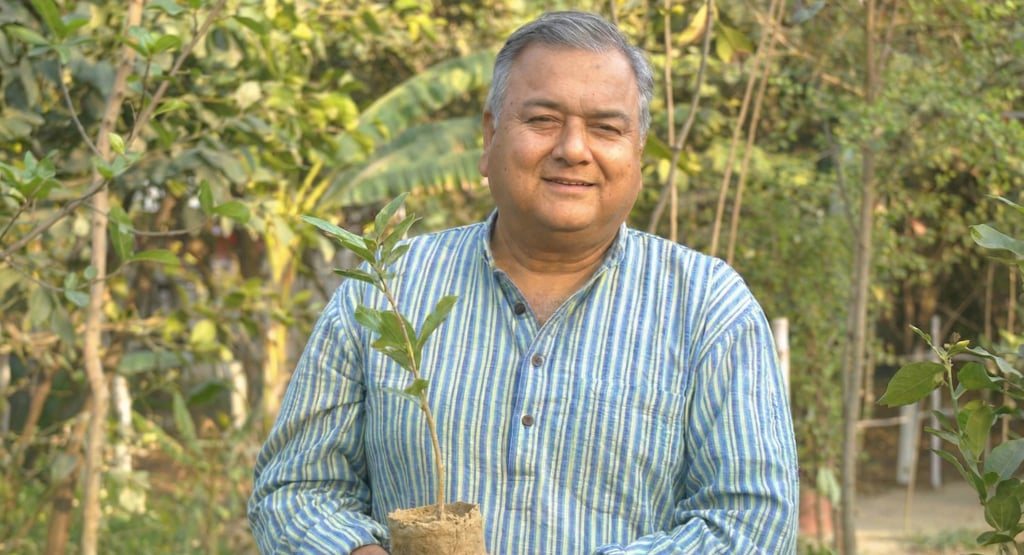
On the margins of India’s busiest cities—along highways, flyovers, hospitals, schools, and government campuses—one figure has quietly worked for decades, doing something most people support in theory but few practice consistently: planting and protecting trees.
Known widely as Peepal Baba, Swami Parmanand Giri has spent much of his adult life focused on environmental restoration, particularly the planting and preservation of native trees such as peepal, banyan, and neem.
His work has not been seasonal or symbolic. It has been sustained, physical, and long-term.
From Observation to Action
Peepal Baba’s journey began in Delhi, where as a young man he became deeply interested in trees—especially peepal trees growing naturally in difficult urban conditions. He observed how these trees survived in cracks of buildings, near roads, and in neglected spaces, often without care.
Rather than approaching the issue as an academic or activist, he chose a practical path: planting trees himself and ensuring their survival.
Over time, this focus became his life’s work.
Planting Where It Matters
One of the defining features of Peepal Baba’s environmental work is location. Instead of planting trees in controlled or ceremonial spaces, he has focused on public land—places where trees are most needed but least prioritized.
These include:
Road dividers and highways
Institutional campuses
Hospitals and schools
Open government land
The emphasis has consistently been on native species, chosen for their ecological value and ability to survive local conditions.
He is also known for stressing that planting a sapling is only the first step; protecting it until it becomes self-sustaining is equally important.
Recognition Without Commercialization
Over the years, Peepal Baba’s work has been acknowledged by civic authorities, environmental bodies, and educational institutions. He has been invited to speak about environmental responsibility and tree conservation, particularly in urban contexts.
Despite this recognition, his work has remained largely non-commercial and non-institutional. There is no large organization built around his name, no branding of his efforts, and no monetization of his identity.
The work continues quietly, often away from public attention.
Redefining Environmental Action
What sets Peepal Baba apart is not just the act of planting trees, but the consistency of the act over decades. His approach challenges the idea that environmentalism must always be large-scale, policy-driven, or technologically complex.
Instead, his life demonstrates a simpler truth:
Long-term commitment matters
Native ecology matters
Individual action, repeated daily, compounds
In an era of campaigns and hashtags, his work represents continuity.
Why His Story Resonates
Peepal Baba’s story resonates because it is grounded in action rather than rhetoric. He does not position himself as a reformer or a crusader. He simply does the work—year after year.
As cities expand and green cover becomes increasingly fragile, his contribution stands as a reminder that environmental protection is not always about innovation. Sometimes, it is about persistence.
A Legacy That Grows Silently
Trees planted decades ago now stand tall along roads and public spaces—offering shade, improving air quality, and supporting local ecosystems. Many people pass them daily without knowing who planted them.
And that anonymity appears intentional.
Because for Peepal Baba, the focus has never been on being remembered—
only on ensuring that the trees remain.